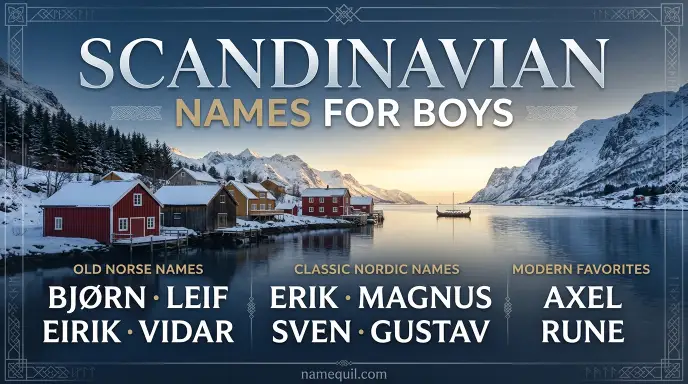
Scandinavian names for boys include strong Old Norse names, classic Nordic favorites, and modern choices from Denmark, Norway, and Sweden. Popular options include Erik, Bjørn, Leif, Axel, Magnus, and Soren. Some have roots in Viking history, while others come from Latin, Greek, or biblical traditions that became part of Scandinavian culture.
If you want a traditional Nordic name, a rare name with an old-world feel, or an easy-to-pronounce choice, this guide offers names, meanings, origins, and practical tips to help you choose.
What Are the Best Scandinavian Names for Boys?
The best Scandinavian boy names combine a sound you enjoy with a meaning or cultural background that feels right. Erik, Axel, Leif, Magnus, and Bjørn are good starting points because they have established Nordic connections. For a less familiar choice, consider Einar, Sten, Vidar, or Trygve.
Here are 15 names worth exploring first.
| Name | Common meaning or association | Style |
| Erik | Often interpreted as eternal or ever-ruling | Classic |
| Axel | Associated with the meaning “father of peace” through Absalom | Modern and traditional |
| Bjørn | Bear | Nature-inspired |
| Leif | Heir or descendant | Short and historic |
| Magnus | Great or mighty | Regal |
| Soren (Søren) | Danish form of Severinus | Refined |
| Einar | Traditionally associated with a lone warrior | Old Norse |
| Lars | Scandinavian form of Laurence | Timeless |
| Arne | Eagle | Short and traditional |
| Sten | Stone | Minimalist |
| Vidar | Name associated with a Norse god | Mythological |
| Trygve | Trustworthy or faithful | Distinctive |
| Nils | Scandinavian form of Nicholas | Familiar |
| Gustav | Traditional Swedish royal name | Stately |
| Rune | Secret lore or rune, depending on linguistic context | Mysterious |
Meanings can vary across historical sources, spellings, and languages. Some names also have more than one possible etymology, so the descriptions above are useful guides rather than universal definitions.
Traditional Scandinavian Boy Names
Traditional Scandinavian names have deep roots in Nordic history. Some appear in Viking Age records, while others became established through Christianity, royal families, and later naming customs. These names work well if you want a choice with a strong regional identity and a long history of use.
| Name | Origin or meaning | Best suited to |
| Erik | Old Norse name traditionally interpreted as “ever-ruler” | A familiar Nordic classic |
| Bjørn | Norwegian and Danish form of a name meaning “bear” | Nature lovers |
| Leif | Old Norse; heir or descendant | A short, historic choice |
| Arne | Old Norse; eagle | A simple, traditional name |
| Harald | Norse name associated with an army and rule | A commanding, royal style |
| Knut | Scandinavian form of a name meaning “knot” | A distinctive classic |
| Olav | Norwegian form of an old Norse name associated with ancestors and inheritance | A heritage-inspired choice |
| Sven | Scandinavian name historically associated with a young man or attendant | A familiar Nordic sound |
| Gunnar | Old Norse name associated with battle and a warrior | A bold traditional choice |
| Ivar | Old Norse name with an uncertain or debated full interpretation | A compact, historic name |
| Rolf | Short form of Rudolf, with Germanic roots associated with fame and wolf | A strong vintage name |
| Håkon | Norwegian form of an Old Norse name associated with high status and family | A distinctly Norwegian option |
| Einar | Old Norse; commonly interpreted as a lone warrior | A heroic, traditional choice |
| Frode | Norse name associated with wisdom | A thoughtful, classic option |
| Trygve | Old Norse; trustworthy or faithful | A meaningful, less common choice |
Several of these names have appeared in Scandinavian history for centuries. The National Museum of Denmark documents names such as Erik, Arne, Bjørn, Harald, Knut, Leif, and Sven among names associated with the Viking Age. That historical connection makes them useful choices for families interested in Nordic heritage.
Old Norse Boy Names With Strong Meanings
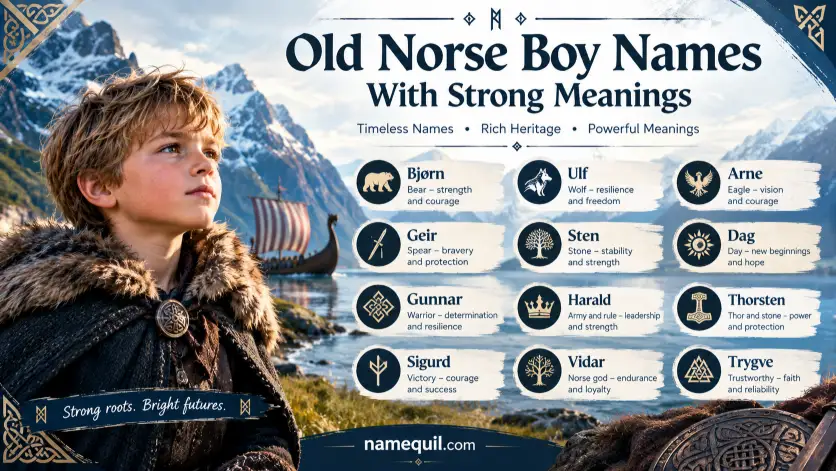
Old Norse names often draw on animals, nature, family, battle, and personal qualities. Many were formed from meaningful word elements, so their original interpretations can offer a glimpse into the values and language of early Nordic communities.
Consider these options if you want a name with an older Norse background rather than simply a name that is popular in Scandinavia today.
| Name | Commonly given meaning or association |
| Alf | Elf |
| Arne | Eagle |
| Bjørn | Bear |
| Einar | Lone warrior |
| Geir | Spear |
| Gunnar | Warrior or battle-related name |
| Harald | Associated with army and rule |
| Leif | Heir or descendant |
| Rune | Rune or secret lore |
| Sten | Stone |
| Ulf | Wolf |
| Vidar | Name of a Norse god |
| Sigurd | Traditionally associated with victory and protection |
| Torsten | Thor and stone |
| Trygve | Trustworthy or faithful |
Some meanings are more straightforward than others. For example, Bjørn and Ulf have clear animal associations, while compound names such as Sigurd and Torsten need to be understood through their historical linguistic elements.
If historical accuracy matters to you, check the specific spelling and etymology rather than assuming every modern Nordic name is a direct survival from the Viking Age.
Danish Boy Names
Danish boy names include traditional Scandinavian forms, short everyday names, and names that came from wider European religious and historical traditions. The spellings may look different from their Norwegian or Swedish counterparts, even when the names share a common history.
| Name | Meaning or origin | Style |
| Axel | Danish form associated with Absalom; “father of peace” | Strong and modern |
| Søren | Danish form of Severinus | Distinctive |
| Mads | Danish form of Matthias | Short and friendly |
| Jens | Danish form related to Johannes | Traditional |
| Niels | Danish form of Nicholas | Classic |
| Knud | Danish form of Knut | Historic |
| Valdemar | Slavic-origin name adopted into Danish royal history | Regal |
| Asger | Old Norse name associated with a god and a spear | Traditional |
| Troels | Danish form of an older name associated with Thor | Distinctive |
| Bjarne | Related to the Scandinavian name element for bear | Nature-inspired |
Best picks: Choose Mads or Jens for a short Danish name, Søren for a recognizable regional character, or Valdemar for a stately historical feel.
Remember that Danish characters such as ø are part of the correct spelling of names like Søren and Niels-related regional forms. You can use an anglicized spelling where practical, but the original form preserves the name’s local identity.
Norwegian Boy Names
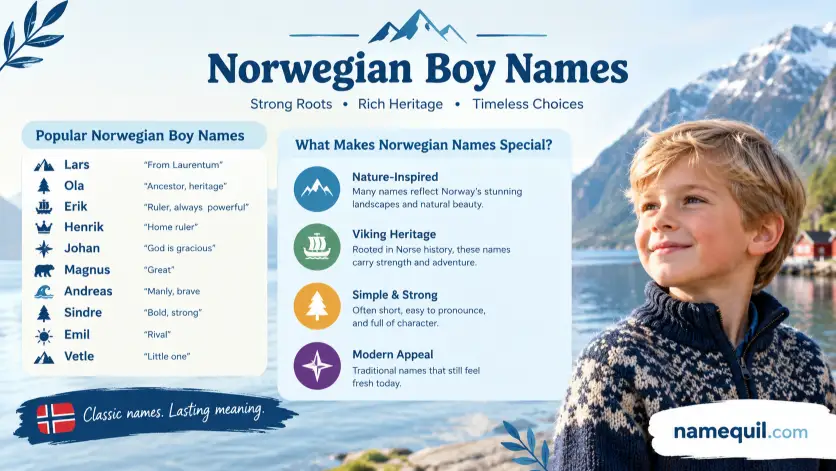
Norwegian boy names include many distinctive Old Norse forms, along with familiar Scandinavian names. Names with letters such as å, ø, and æ can give a choice a particularly Norwegian appearance.
| Name | Meaning or association | Style |
| Håkon | Associated with high status and family | Royal and traditional |
| Eirik | Norwegian form related to Erik | Historic |
| Olav | Norwegian royal and traditional name | Classic |
| Trygve | Trustworthy or faithful | Meaningful |
| Bjørn | Bear | Nature-inspired |
| Arne | Eagle | Short and traditional |
| Leif | Heir or descendant | Historic |
| Sindre | Norwegian name with traditional Norse associations | Distinctive |
| Vegard | Traditional Norwegian name with a debated compound interpretation | Uncommon |
| Øystein | Old Norse name associated with an island and stone | Strong and regional |
Best picks: Eirik and Olav are good choices for a traditional Norwegian feel. Bjørn and Arne suit readers who prefer names connected with nature, while Øystein is worth considering if you want a more distinctly Norwegian spelling.
For an authentic choice, keep the Norwegian spelling when possible. If the name will often be written in English, think about if you are comfortable explaining the pronunciation or using a simplified spelling in some settings.
Swedish Boy Names
Swedish boy names range from short, clean-sounding choices to names associated with royal history. Some are shared across Scandinavia, while others are especially familiar in Swedish spelling or usage.
| Name | Meaning or association | Style |
| Gustav | Traditional Swedish royal name; ultimate etymology is debated | Regal |
| Sten | Stone | Short and strong |
| Åke | Swedish form of an older Scandinavian name | Distinctive |
| Nils | Swedish form of Nicholas | Classic |
| Björn | Bear | Nature-inspired |
| Karl | Germanic name meaning “free man” | Traditional |
| Erik | Classic Nordic name | Timeless |
| Albin | From Latin albinus, associated with “white” | Gentle |
| Folke | Old Scandinavian name with historic usage | Vintage |
| Oskar | Scandinavian spelling of Oscar | Familiar |
Best picks: Gustav is a strong option for a name with Swedish royal associations, while Sten offers a simple and compact sound. Nils and Erik are useful choices if you want a traditional name that also feels familiar internationally.
A name’s presence in Swedish culture does not always mean it originated in Sweden. Karl, Oskar, and Albin, for example, have broader European linguistic histories.
Unique Scandinavian Names for Boys
If you want a name that feels Nordic without choosing one of the most familiar options, look at less common traditional names. Some are rooted in Old Norse, while others have a more regional or historical character.
| Name | Meaning or association | Why consider it |
| Agne | Swedish form related to Old Norse Agni | Short and historic |
| Alf | Elf | Simple and memorable |
| Asmund | Old Norse name with elements associated with a god and protection | Ancient feel |
| Bjarne | Bear-related name | Warm and distinctive |
| Dag | Day | Minimalist |
| Geir | Spear | Strong and brief |
| Jarl | Earl or nobleman | Regal |
| Rune | Rune or secret lore | Mysterious |
| Snorre | Traditional Norwegian name | Strong regional character |
| Steinar | Stone-related name | Rugged |
| Toke | Historic Danish name | Short and unusual |
| Vidar | Name of a Norse god | Mythological |
| Yngve | Name associated with an old Norse deity | Heritage-focused |
| Ødger | Historic Scandinavian form with a spear-related association | Rare-looking |
| Åge | Traditional Scandinavian name with an older history | Distinctive |
Unusual spellings can be appealing, but they may also lead to repeated pronunciation or spelling questions outside Scandinavia. If ease of use matters, Dag, Alf, Rune, and Jarl are relatively compact choices.
The meaning of a compound name may depend on how its older elements are interpreted. Check an established etymological reference before treating a rare name’s popular online meaning as certain.
Cool Scandinavian Boy Names
Cool Scandinavian boy names often combine clear sounds, strong consonants, and a distinctive Nordic feel. You do not need to choose a name from mythology to get that style. A classic name with a clean spelling can work just as well.
| Name | Style | Why it stands out |
| Axel | Modern classic | Strong sound and familiar spelling |
| Erik | Timeless | Recognizable across many countries |
| Leif | Minimalist | Short with a historic background |
| Magnus | Bold | Has a powerful, established feel |
| Sten | Rugged | Brief and easy to remember |
| Rune | Mysterious | Connected with runic writing and lore |
| Arvid | Traditional | A distinctive Scandinavian sound |
| Soren (Søren) | Refined | Recognizable Danish identity |
| Viggo | Vintage-cool | Compact and memorable |
| Ivar | Historic | Short, bold, and rooted in Nordic naming |
| Nils | Simple | Easy to use in many settings |
| Gustav | Stately | Strong royal associations |
For an international setting, Axel, Erik, Magnus, and Nils are practical options because their spellings are relatively familiar to many English speakers. If cultural specificity is your priority, Søren, Leif, and Sten have a more distinctive Nordic character.
Scandinavian Boy Names Inspired by Norse Mythology
Norse mythology offers names connected with gods, legendary figures, and old stories. These choices can appeal to readers who enjoy Nordic literature and mythology, but a mythological connection is not the same as proof that every name was commonly used in the Viking Age.
| Name | Mythological connection | What to know |
| Thor | Norse god of thunder | Direct and recognizable |
| Balder | God associated with beauty and light in Norse tradition | Gentle yet historic |
| Vidar | God associated with vengeance and survival after Ragnarök | Uncommon and meaningful |
| Freyr | God associated with fertility, prosperity, and peace | Strong mythological link |
| Bragi | God associated with poetry | Literary feel |
| Tyr | God associated with law and heroic combat | Very short |
| Loki | Trickster figure in Norse mythology | Bold and strongly associated with the stories |
| Heimdall | Guardian of the gods in Norse mythology | Dramatic and distinctive |
| Odin | Chief god in Norse mythology | Powerful cultural association |
| Yngve | Name associated with the Norse figure Yngvi | Traditional Nordic feel |
A practical tip: Thor and Odin are immediately recognizable as mythological names, while Vidar and Bragi may feel more subtle. Consider if you want the mythological story to be central to the name or simply part of its background.
Short Scandinavian Boy Names
Short names are easy to remember and can work well with longer surnames. Scandinavian languages offer several compact choices, from everyday classics to names with older Norse roots.
| Name | Meaning or association | Length |
| Bo | Danish and Swedish name; associated with living or dwelling | 2 letters |
| Dag | Day | 3 letters |
| Alf | Elf | 3 letters |
| Ulf | Wolf | 3 letters |
| Jan | Form of Johannes | 3 letters |
| Nils | Form of Nicholas | 4 letters |
| Sten | Stone | 4 letters |
| Erik | Classic Nordic name | 4 letters |
| Leif | Heir or descendant | 4 letters |
| Rune | Rune or secret lore | 4 letters |
| Arne | Eagle | 4 letters |
| Ivar | Traditional Norse name | 4 letters |
If you want the name to be easy to spell internationally, Erik, Jan, and Bo are straightforward choices. For a nature-inspired option, consider Ulf or Arne. If you prefer a name with an old-world feel, Leif or Sten may be a better fit.
Scandinavian Boy Names With Nature Meanings
Nature-inspired names can reflect the animals, landscapes, and natural world associated with Nordic culture. Some have direct meanings in Scandinavian languages, while others have older etymologies that are less certain.
| Name | Nature connection | Style |
| Bjørn | Bear | Strong |
| Ulf | Wolf | Bold |
| Arne | Eagle | Traditional |
| Sten | Stone | Grounded |
| Dag | Day | Minimalist |
| Rune | Runic symbols and secret lore | Mysterious |
| Leif | Heir or descendant; not directly a nature name | Historic |
| Vidar | Mythological association with the natural and divine world | Mythological |
| Geir | Spear, rather than a direct nature meaning | Strong |
| Øystein | Traditionally associated with island and stone elements | Regional |
For a clear animal meaning, Bjørn and Ulf are among the most direct choices. Sten works well if you prefer a simple name associated with a physical element. Rune suits readers who are drawn to the history of Nordic writing rather than a literal nature meaning.
How to Choose the Right Scandinavian Boy Name
The right name depends on what matters most to you: cultural background, meaning, sound, spelling, or how well it works where you live. Start with a few names that appeal to you, then compare their origins and everyday use before making a shortlist.
Decide Which Nordic Tradition You Prefer
Scandinavia includes Denmark, Norway, and Sweden. Nordic naming traditions are broader and can also include Iceland and the Faroe Islands. If you want a name tied to a specific country, check its local spelling and use rather than relying only on a general “Scandinavian” label.
- Danish: Søren, Mads, Jens, Knud.
- Norwegian: Håkon, Eirik, Olav, Trygve.
- Swedish: Gustav, Åke, Folke, Sten.
- Shared Nordic choices: Erik, Nils, Bjørn, Leif.
These categories are guides, not strict boundaries. Many names cross national borders and appear in more than one Scandinavian language.
Choose a Meaning That Matters to You
If meaning is important, narrow your options by theme. For strength and boldness, look at names such as Gunnar or Magnus. For nature, consider Bjørn, Ulf, or Arne.
Keep in mind that traditional meanings can be debated, especially when a name comes from an old compound. Confirm the etymology before relying on a single translation.
Consider Pronunciation and Spelling
A name may look simple on a page but sound different in another language. Letters such as å, ø, æ, and ø carry specific sounds in Scandinavian languages and should not be treated as decoration.
Ask yourself:
- Can people in your community pronounce the name comfortably?
- Do you want to preserve the original Scandinavian spelling?
- Would an anglicized spelling make everyday use easier?
- Does the name sound good with the family surname?
There is no single right answer. The best choice balances your connection to the name with practical everyday use.
Decide Between Traditional and Modern Style
A historic name can feel distinctive today, while a short familiar name can feel timeless. Erik, Nils, and Axel are good starting points for an accessible style. Names such as Snorre, Øystein, and Yngve offer a more traditional or regionally distinctive feel.
Try saying each name aloud with the surname and any middle names you are considering. This simple step can help you notice awkward rhythms or initials before settling on a favorite.
Verify the Name’s Cultural Background
Do not assume that every name used in Scandinavia is originally Norse. Some came from Latin, Greek, Hebrew, Germanic, or Slavic sources and became established through religion, migration, royal families, or everyday use.
Frequently Asked Questions
Q1. What are the most popular Scandinavian boy names?
Erik, Axel, Magnus, Nils, and Leif are familiar Scandinavian choices. However, popularity varies by country and year. Check current official statistics from Denmark, Norway, or Sweden if you want to know which names are most popular today.
Q2. What is a strong Scandinavian name for a boy?
Magnus, Gunnar, Harald, and Ivar are strong-sounding traditional options. Magnus has a meaning associated with greatness, while Gunnar has a battle-related Old Norse background. Choose based on the name’s sound and verified origin rather than strength alone.
Q3. What Scandinavian boy names come from the Viking Age?
Names associated with the Viking Age include Erik, Arne, Bjørn, Harald, Knut, Leif, Sven, and Ulf. Historical records, runic inscriptions, and later sources help researchers identify names used during that period.
Q4. What is a rare Scandinavian boy name?
Agne, Snorre, Toke, Yngve, and Øystein may feel less familiar to readers outside Scandinavia. If a name is rare depends on the country and period, so check local statistics before treating any name as uncommon.
Q5. What Scandinavian boy names are easy to pronounce in English?
Erik, Axel, Magnus, Nils, and Arne are practical starting points for many English speakers. Names with Scandinavian characters, such as Bjørn, Håkon, and Søren, may need a little explanation, but their original spellings can preserve important cultural details.
Q6. Are Scandinavian and Viking names the same?
No. Scandinavian names include names used across Denmark, Norway, and Sweden from many linguistic and cultural sources. Viking names refer more specifically to names used during the Viking Age or associated with Norse history and mythology. Some names belong to both groups.
Q7. What is the difference between Scandinavian and Nordic names?
Scandinavian usually refers to Denmark, Norway, and Sweden. Nordic is broader and also includes Iceland, Finland, and the Faroe Islands. The naming traditions overlap, but each country and language has its own history and patterns.
Q8. Do Scandinavian boy names have special characters?
Some do. Danish, Norwegian, and Swedish names may use letters such as å, æ, and ø, depending on the language and name. These letters are part of standard spelling, not optional decoration. If you choose an alternative spelling, check if it changes the pronunciation or cultural form.
Conclusion
Scandinavian names for boys offer a wide range of styles, from familiar classics such as Erik and Magnus to traditional choices such as Trygve, Sten, and Øystein. Some connect directly with Old Norse language and mythology, while others reflect centuries of cultural exchange across Europe.
Start by choosing the style and meaning that matter most to you. Then confirm the name’s origin, check its spelling in the relevant Scandinavian language, and say it aloud with the surname. A little research will help you choose a name that feels distinctive, meaningful, and suitable for everyday life.
You May also Like:
- Baby Girl Names Starting With A: Beautiful Ideas and Meanings
- Boy Names That Mean Peace: 45 Meaningful Choices
- Male Names That Mean Fire: Powerful Names With Fiery Meanings

I’m Olivia Bennett, the author behind namequil.com, where I research names, their meanings, origins, and cultural connections to create simple, helpful naming guides. My goal is to uncover the stories behind names and help readers find one that feels meaningful and memorable.